
How we are all just (mentally) switching off
What can we actually do?


Twenty years ago it would not have been possible to stand with your toes in the surf on a beach in NZ and call someone in the UK, but now that is standard. The world no longer feels inaccessible, which means bad news on the other side of the planet doesn’t feel far away. Rewind two hundred years ago to the time before trains and you’d find people who rarely ever left their own village, privy only to news taking place on their doorstep.
Technology evolves far quicker than our brains, which were not meant to consume this much news. And yet if you try to mentally switch off, if you solely use your Twitter (I’ll never use its new name) purely for cat pictures and Instagram for sending mates memes about the 90s and parenting (hey, I’m a millennial), you are accused by others of silence and not engaging with the real world, lambasted for endorsing genocide. Really? Are we really doing this? Are we elevating an app designed by some normcore student in his dorm bedroom to be truly representative of real life? AND YET. This is where we’re at. Apps designed by normcore students in their dorm bedrooms do now run our world. Billionaires can buy them on a whim and run them into the ground. The communities or careers we’ve built up over the years and the walls of our favourite hang-out just crumble to dust in front of us and there’s nothing we can do about it. Capitalism, baby.
Social media is built on bullshit and self-performance. We present ourselves how we wish to be perceived. It explains the videos of Gen Z protestors who cannot explain the meaning of their placards. I feel sympathy for those growing up in a world that demands they run before they can walk, insisting they prove themselves on “the right side of history”. Who wants to be a Nazi? Who, in this current climate of cancel culture or accountability (depending on your viewpoint), wants to risk even being accused? The Crucible did not come from a vacuum. The mantra of younger generations is often “educate yourself” (usually directed towards the older gen - I geddit) and yet as those videos demonstrate, there is precious little time to do so when the world on your screen demands you take action NOW.
And yet, take action how? For every picture of a bloodied car seat, there are a hundred comments saying there were no beheaded babies. Fake news! For every video showing a Palestinian hurrying through rubble carrying a baby, there is another suggesting it is Hamas carrying dolls. Fake news! Who are we to know the truth? Do we fall back on belief and cling to the identities carved out for ourselves, as if they are infallible? My kin would never do this. Dangerous ground. I don’t know what is true and what isn’t. There is no way to know if the source is reliable. Media institutions often get things wrong, and yet the child in me likes to hope they are reliable, because children are naive in their desire for safety.
No wonder the young are anxious. The older gens can still distinguish between online/the real world, but GenZers have grown up with online being just as real as the world in which their hearts beat. Ooh baby. We’ve invented one heck of a cocktail. This online world demands a contribution, wrapping them up in traction/comments/likes (which only come if the algorithm favours what they’ve posted; we cannot even get traction unless we first satisfy the pre-programmed beast). It wants the youth fully-formed now, their words permanent on a screen. They cannot be carried from the club with vomit in their hair without someone recording it, enjoy stumbling and finding their way, learn through failing. Failing means possible cancelling, and cancelling means: no more. (Another millennial comment: I’m so glad I’m not growing up today.)
Also, I don’t want to admit it, but there is a part of me that doesn’t want to see these bloody images when I am looking to an app for escapism. That part of me is clearly a hangover from the twentieth century when we actively sought out our news. Now it follows us everywhere. The cries of those Palestinian children who know nothing of history or land, pictures of traumatised girls and women with blood patches on the rear of their tracksuits being herded into trucks; they follow me everywhere. As they should.
Embedding ourselves in our phones can completely skewer our judgement and make us think the real world lives solely in our screen (not your world-view; my world-view). Who wouldn’t be sent mad by this? Hence why we retweet cat pictures and laugh at posts about being terrible mothers. It is hard to know which way to go and so we often retreat into stasis or inertia. Stuck, preferring mud to quicksand.
I don’t know what the answer is. On the one hand, we cannot simply fill our minds with cat pictures and memes. Do we want to be part of a society consumed by cat pictures and memes? I don’t. And yet this barrage of bad news every day can overwhelm even the healthiest of minds. It is not only the volume of news but the reminder that there is nothing we can really do. We can march, sure, but as individuals we are powerless. All I can offer a place thousands of miles away is useless tears.

I grew up with the story of the Good Samaritan. A Jewish traveller is stripped, beaten, and left for dead on the road, then ignored by two men of the same faith who stumble upon him, one after the other. They cross the road and walk on. Shortly after, a Samaritan comes along and finds the man. Jews and Samaritans were generally antagonistic towards each other, but this man immediately picks up the fallen Jew, takes him to an inn and helps him back to health. He pays for the room and the care that the man requires.
I’ve always loved this story and its simplicity. It perfectly encapsulates the life I want to live. It used to frustrate me in my previous life when my community would only help themselves during national disasters or times of need. They were excellent at assisting those like them, but not so much outsiders, who are generally viewed with suspicion. And yet the point of the story of the Good Samaritan is to help those who are different than us. Ignore labels and identity. Just…help.
We cannot rescue those children in Palestine. We cannot release those hostages or stop those women being raped. Perhaps collectively we can make a fuss, but as individuals, we are powerless. However, what if we pulled back a little from the phenomenon of the past decade of smartphones making the world seem so small and…make it smaller? What if we go back to focusing on our village?
By this, I do not mean burying heads in sand, but looking out for those fallen in our own street. Who are the people around us most in need of help? How can we put ourselves out for someone else? The internet has allowed us to curate our own communities and connect with people all over the world - a brilliant thing - but these people only exist online. They are avatars who come alive only through typing… . We cannot touch them. Perhaps it’s time to make our circle local again, if only to tap in to the very basics of what it means to be human: face to face, hand to hand, eye to eye. The avenues of 21st Century communication are shiny and new, but they should not completely replace the roads that led us here.
It is easier to dehumanise those we only know through a screen. They are “Jews”, “Muslims”, “right-wingers”, “snowflakes”, “millennials”, “boomers”. They are not real, but a blob. Who has room for nuance with only x number of characters in a tweet? People on screens are two-dimensional, and that missing third dimension dilutes their humanness as well as our own humanity. When we cannot see people or be seen by them, we are meaner. We don’t consider them as real as those we meet face-to-face.
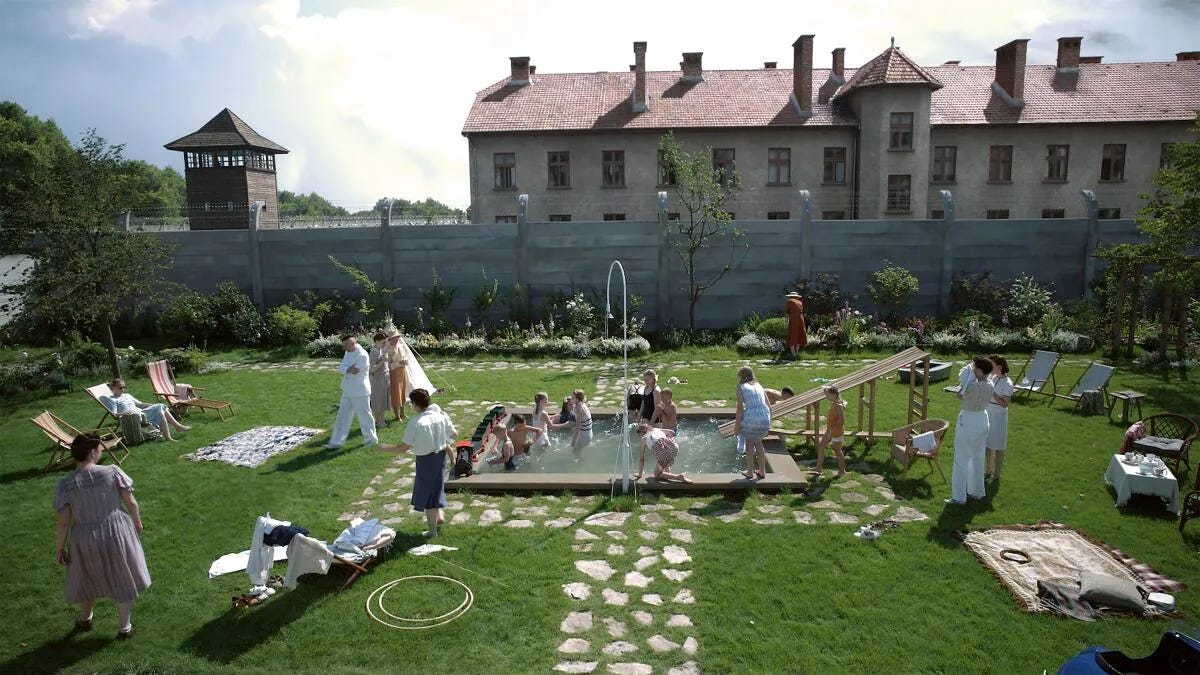
In The Zone of Interest (which I write about here), the Nazi wife of the Auschwitz commandant finds purpose and meaning through building a home for her family on the edge of the death camp. Hedwig spends her time furnishing her house and pruning her beautiful garden, whose boundary is the camp wall. As she tends to her plants, there are shots and cries in the air. She does not hear them. She is consumed by the world of her own making. Perhaps for the sake of her own mental health, she would rather not know what goes on on the other side of that wall. She never comes face-to-face with a Jew. In another scene of her in bed with her husband, she asks him to take her to a spa for ‘a little pampering’. She is fashioning herself a beautiful life.
I too, want to fashion for myself a beautiful life. I want to build a home for my family, to watch my boys grow tall and strong, healthy, safe. I want to spend summer days in the garden, drunk on the scent of plants, staring at blue sky. I too want a little pampering. I too like to switch off from what is happening in the world for the sake of my mental health. This is why the film rightly left me so uneasy. What is the difference between me and Hedwig Hoess? Truly? It is not wrong to want a lovely life, but where is the line between self-protection and apathy?
Another scene in the film - thermal photography giving it a dreamlike feel - shows a young girl working under the cover of night to hide apples for starving prisoners to find. She scatters them around shovels, pressing them into the earth. Director Jonathan Glazer revealed that this came from a true story:
She was a local Polish, non-Jewish girl who lived locally and felt compelled to do what she could for prisoners. It was the simple, pure goodness in her that made me feel like I could carry on with this project because there was an opposition to this dark force. There was an energy that was human; we also have the capacity for goodness. She really did become my North star in many ways for this whole project. [Source: Vanity Fair]
This girl stayed local. She came to the aid of those on her street. She did not allow her powerlessness as an individual to stop her from doing something. Did it stop the Nazis? No. Did it amount to visible change? Hardly. But it is through small acts of resistance or kindness that we change the world. In Schindler’s List, Itzhak Stern quotes from a Hebrew text: ‘Whoever saves one life, saves the world entire’. Perhaps small acts of kindness do not literally save a life, but if we can turn our helplessness into a force of good, how might that change our own world? Perhaps the person we help feels motivated to pay that kindness forward, and perhaps that rolling stone would then gather no moss.
I still have no concrete answers. I am torn by complicated feeling. Sadness, anger, confusion. The knowledge I am not doing enough. None of my words will really change the discourse, and yet speaking them aloud, typing black onto white, is a tiny act in itself. If mental health is worsened through retreating into ourselves and our own devices, of finding the world too hard to handle, perhaps we should respond by changing our tiny world. Putting down the device. Taking out the ear bud. Connecting with each other as humans have always connected: face to face.
Such a thoughtful and beautifully written piece, Jodie. It captures how I feel so often these days and I'm sure many others do too. I wonder how we can work around (or perhaps I mean avoid?) this digital/ device obsessed world we now live in, without losing sight of what's going on globally, locally and personally.